
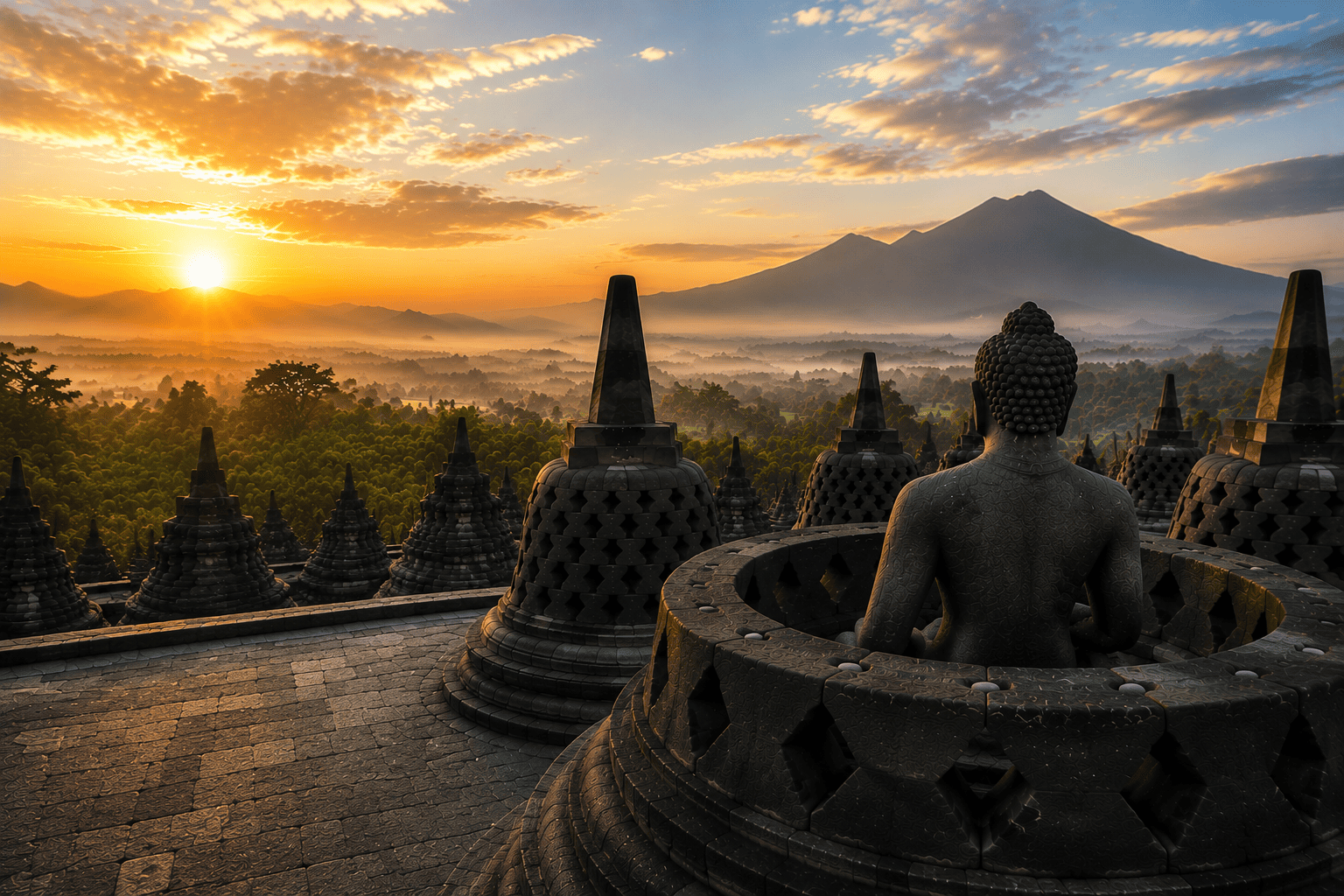
The Borobudur 2007 Wonder Campaign became an important moment in the international recognition journey of Indonesia’s most famous Buddhist monument. During this period, Borobudur attracted worldwide attention as one of the nominated landmarks in the New7Wonders of the World campaign.
Many people still believe that Borobudur became one of the official Seven Wonders winners in 2007. However, the temple participated only as a nominated site and was not included in the final list of selected winners.
The campaign increased global awareness of Borobudur, but the temple’s historical value existed long before this competition.
The Background of the 2007 Wonder Campaign
The New7Wonders campaign was launched in 2001 by Bernard Weber as a private initiative. The project aimed to create a modern list of famous landmarks through worldwide public voting.
Unlike UNESCO World Heritage recognition, the campaign used popularity-based voting to determine the final results.
Thousands of landmarks from different countries were considered during the selection process. Borobudur became one of the nominated sites because of its impressive architecture, Buddhist symbolism, and ancient history.
The campaign encouraged people around the world to learn about remarkable cultural monuments.
Visitors can explore more about this topic through Why is Borobudur not one of the 7 wonders? The real reason explained.
Borobudur’s Participation in the Campaign
During the Borobudur 2007 Wonder Campaign, the temple competed with many famous landmarks worldwide. The selection process depended on public votes collected from international participants.
Borobudur received support from many people who appreciated its cultural importance. However, several other monuments gained stronger global campaigns and higher voting numbers.
The final winners were announced in 2007. Borobudur did not become one of the seven selected landmarks.
The result reflected public voting preferences during the campaign. It did not represent a complete evaluation of historical significance, cultural contribution, or architectural achievement.
Why Was Borobudur Not Selected as a Winner?
The main reason relates to the voting system used by the New7Wonders campaign. The competition focused on public participation rather than professional heritage assessment.
Many nominated landmarks had large international communities supporting their campaigns. Media exposure and promotional activities also influenced public awareness.
Although Borobudur represents one of the greatest achievements of ancient civilization, the final decision depended on vote totals.
Not winning the competition does not reduce Borobudur’s importance as a cultural monument.
Difference Between New7Wonders and UNESCO Recognition
The Borobudur 2007 Wonder Campaign should be understood separately from UNESCO World Heritage recognition.
UNESCO recognized Borobudur as a World Heritage Site in 1991. This recognition was given based on professional criteria, including cultural significance, authenticity, conservation, and historical value.
The New7Wonders campaign used public voting, while UNESCO applies expert evaluation methods.
These two systems have different goals. One measures global popularity, while the other identifies sites with outstanding universal value.
Travelers who want to experience this extraordinary monument can join a Borobudur Temple tour to discover its history, architecture, and spiritual meaning.
Borobudur’s Value Beyond the Campaign
A monument’s importance cannot be determined only by competition results. Cultural influence, historical legacy, and preservation efforts also define its value.
Borobudur continues to impress visitors because of its unique structure and spiritual symbolism. Built during the Sailendra Dynasty between the 8th and 9th centuries, the temple represents advanced artistic and engineering knowledge.
Its thousands of relief panels and hundreds of stupas preserve stories about Buddhism and ancient Javanese culture.
The 2007 campaign helped introduce Borobudur to more international audiences. However, its legacy comes from centuries of history rather than a popularity ranking.
Conclusion
The Borobudur 2007 Wonder Campaign shows that Borobudur participated in a global landmark competition but did not become one of the final New7Wonders winners.
Despite this result, Borobudur remains one of the world’s most valuable cultural monuments. Its UNESCO recognition, extraordinary architecture, and historical significance prove that its importance extends far beyond any competition.
